

KNOWLEDGE CENTER
Advancing Biomolecular Purification
Streamlining the Path to Precision in High-Resolution Separation
In the high-stakes environment of biotechnology research and biopharmaceutical manufacturing, the resolution of biomolecular separation often dictates the clinical and commercial success of downstream applications. While modern laboratories have access to various purification modalities, such as chromatography and TFF, Density Gradient Ultracentrifugation (DGUC) remains the global gold standard for high-resolution isolation of complex biologics.
DGUC offers a unique, non-destructive environment that separates particles based on their fundamental physical properties: mass, size, and buoyant density. However, traditional DGUC has often been perceived as a labor-intensive art, heavily reliant on manual dexterity. Beckman Coulter Life Sciences has re-engineered this journey, providing a standardized preparative workflow that eliminates technical bottlenecks and ensures maximum reproducibility from the laboratory bench to large-scale production.
Core Principles of Separation Science
To optimize a purification strategy, one must first align the separation modality with the target molecule’s physical characteristics:
Isopycnic (Equilibrium) Separation
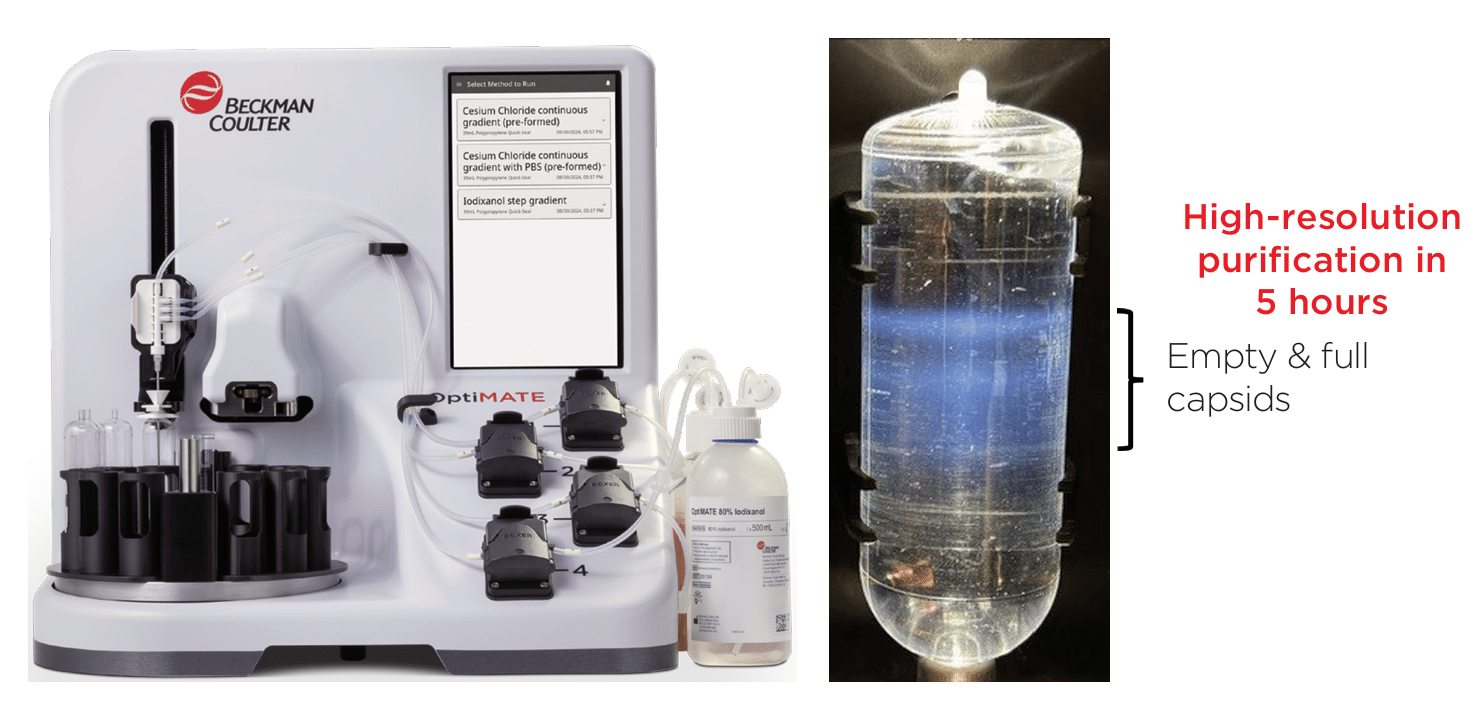
This method relies on buoyant density. Particles migrate through a gradient until they reach a point where the medium’s density matches their own. It is the definitive approach for identifying internal composition differences, such as separating Full gene-carrying viral capsids from Empty or Partial contaminants.
Rate-Zonal (Sedimentation Velocity) Separation
Dictated by the sedimentation coefficient (S), this kinetic approach separates particles based on their mass and shape as they travel through a pre-formed gradient. It is the ideal choice for isolating specific sizes of mRNA-lipid nanoparticles (LNPs), exosome sub-populations, or native protein complexes.
Technical Specifications: Types of Density Gradients
| Feature | Rate Zonal (Velocity) | Isopycnic (Equilibrium) | Equilibrium Zonal |
|---|---|---|---|
| Separation Basis | Size and Mass (S-value) in a pre-formed gradient | Buoyant density in self-forming gradient | Buoyant density in pre-formed gradient |
| Typical Gradient | Continuous (e.g., linear sucrose gradients) | Continuous (e.g., CsCl gradients) | Discrete segments (step gradients) |
| Common Materials | Iodixanol, Sucrose | CsCl, Iodixanol | Iodixanol, Sucrose |
| Advantage / Best For | mRNA-LNPs, Exosomes, VLPs | AAV Full/Empty viral capsids, DNA isoforms | Viral separations requiring concentration |
The Integrated Preparative Workflow
A Standardized Success Path
01. Automated Gradient Engineering (NEW)
The foundation of any high-resolution run lies in the architecture of the gradient. Traditional manual layering is not only labor-intensive but highly dependent on operator skill. Inconsistent layering or micro-bubbles can disturb the gradient under extreme forces exceeding 1,000,000 × g.
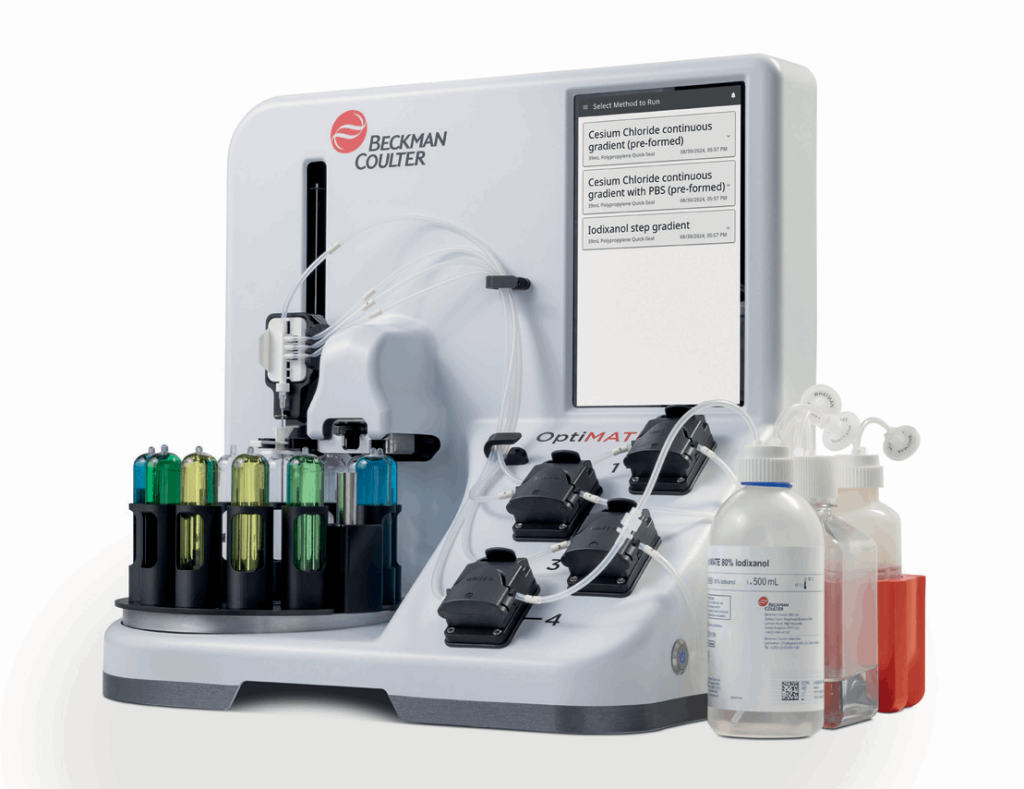
The OptiMATE Gradient Maker addresses these challenges by automating the dispensing of pre-formed linear or step gradients. By bypassing the hours typically required for gradients to self-form during a spin, this technology enables a 75% reduction in total centrifugation run time (e.g., from 20 hours to just 5 hours), ensuring every run starts with a mathematically precise profile.
02. Validated Density Gradient Media (NEW)
A standardized process is only as reliable as the reagents utilized. Manual preparation of density media often introduces lot-to-lot variability or contamination.
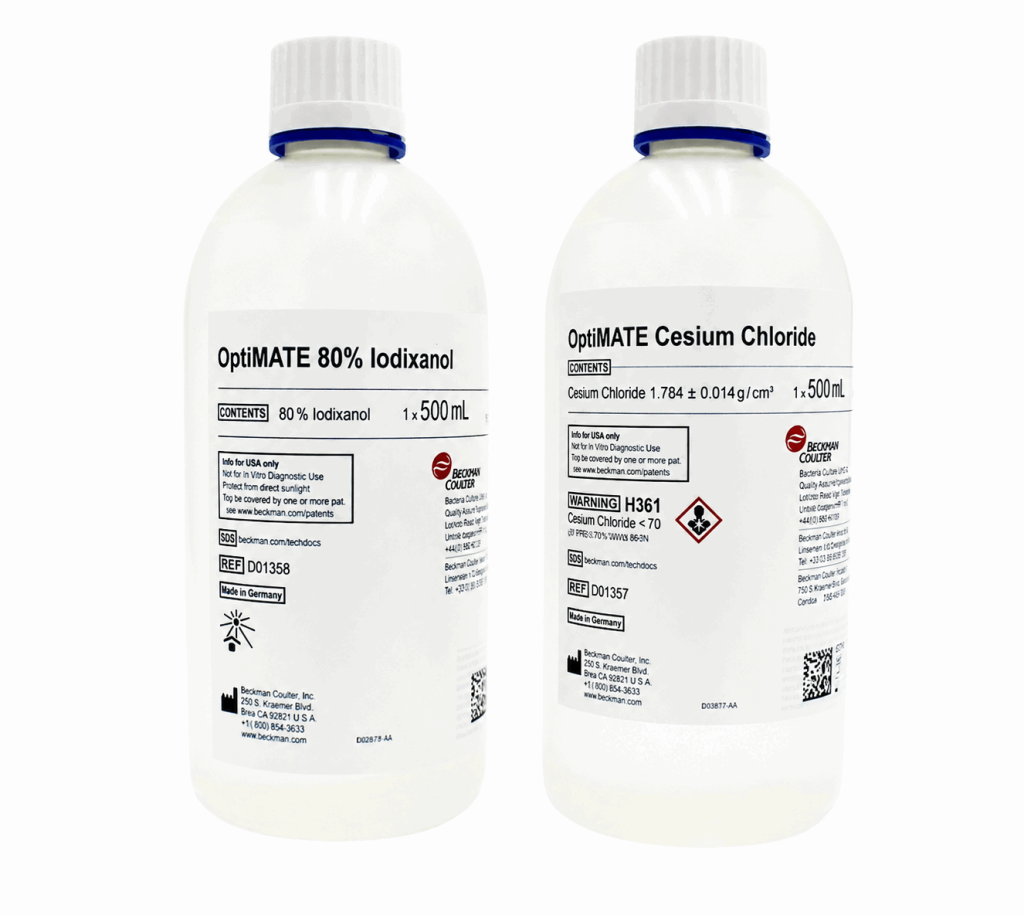
Beckman Coulter provides Validated OptiMATE Cesium Chloride and Iodixanol Solutions. These ready-to-use, sterile, and low-endotoxin (≤ 1 EU/mL) solutions are designed specifically for cGMP-aligned environments, ensuring the density accuracy required for maximum reproducibility across every run.
03. High-Performance Ultracentrifugation:
Power and Scale
At the heart of the workflow is the centrifugal force required to resolve species with minimal density differences. Scientific breakthroughs require absolute control over these forces and stringent thermal stability.
Extreme Performance
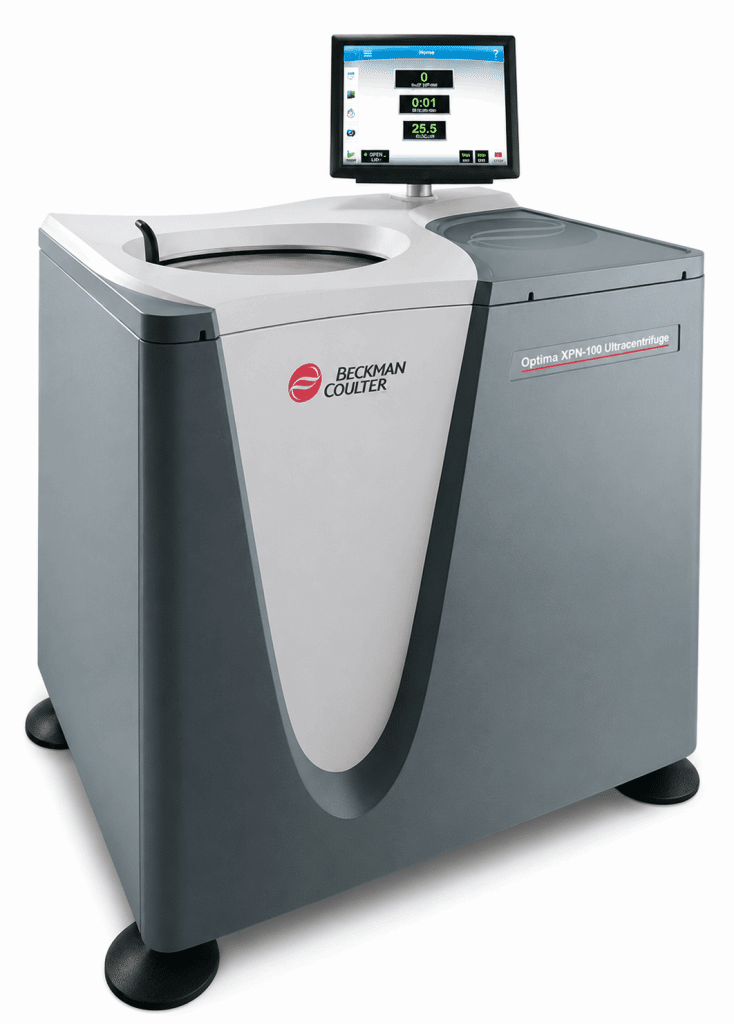
The Optima MAX-XP micro-ultracentrifuge provides industry-leading speeds, reaching forces up to 1,019,000 × g for the most demanding molecular separations.
Scalable Throughput
The Optima XPN series offers high-capacity preparative performance (up to 802,000 × g).
Unrivaled Scalability
The Beckman Coulter ecosystem supports the widest range of volumes transitioning seamlessly from 230 µL analytical micro-samples to 250 mL manufacturing-scale bottles.
04. Standardized Sample Recovery (NEW)
The final critical step, recovering the high-purity bands post-spin, has historically been the most variability-prone.
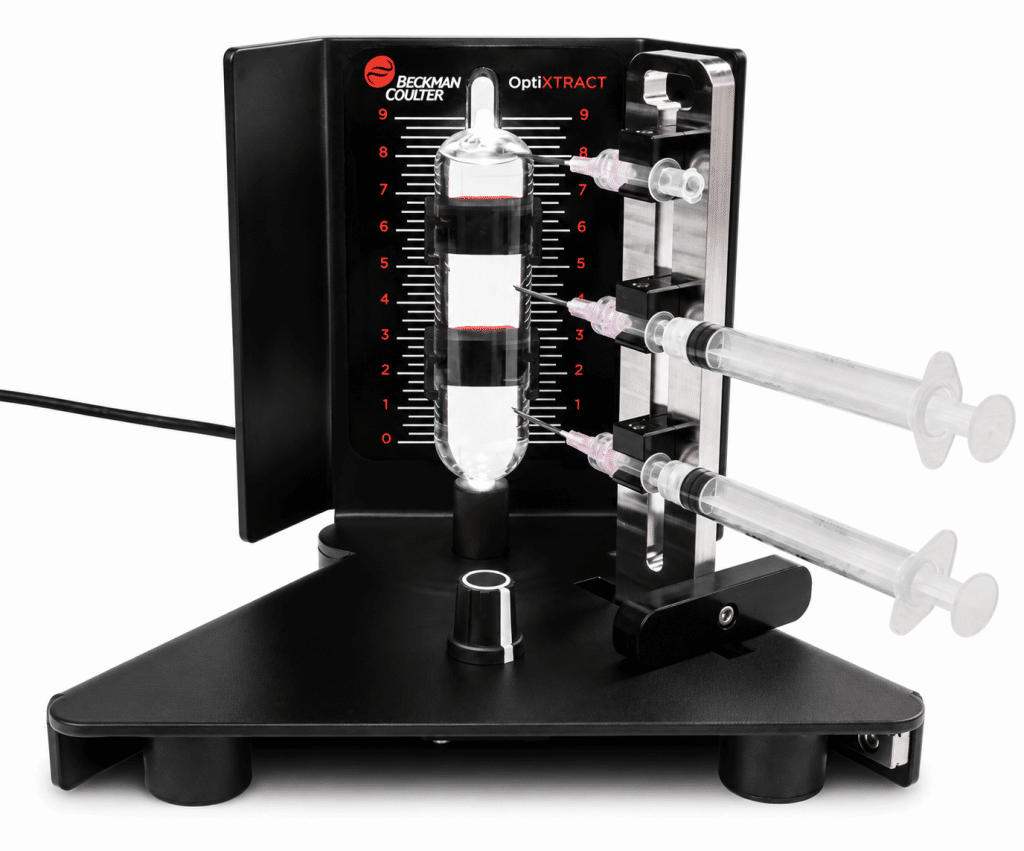
The OptiXTRACT Sample Recovery Aid standardizes this through a guided, hands-free needle piercing system. Equipped with LED-illuminated tube stands, it ensures 100% consistent band extraction across different operators and shifts while ensuring operator safety.
Versatility Across Biological Modalities
The standardized Beckman Coulter workflow provides the scientific depth required for diverse preparative applications:
Viral Vector Purification
Enrichment of AAV (specifically resolving Full/Empty/Partial capsids), Lentivirus, and other gene therapy delivery vectors.
Vaccine Development
High-purity isolation of Virus-Like Particles (VLPs) and mRNA-LNPs, ensuring the complete removal of host-cell proteins and DNA.
Exosomes & EVs
Gentle, non-destructive isolation that preserves membrane integrity and biological potency for functional studies.
Subcellular Fractionation
Efficient isolation of functional organelles, including mitochondria, lysosomes, and nuclei, for proteomic and metabolic mapping.
Nucleic Acid Resolution
High-resolution separation of supercoiled forms from linear or nicked genomic variants.
Native Protein complexes
Purification of ribosomes and large macromolecular assemblies in their bioactive states for structural biology (Cryo-EM).
Expert Application Support in Israel
In the rapidly advancing biotech landscape, technology is only as strong as the expertise behind it. Our local application specialists in Israel bridge the gap between instrumentation and results, providing the technical depth required for method development, protocol optimization, and tech transfer from R&D to GMP-aligned production.
Technical Resource Center
SCIENTIFIC POSTER
Capsida OptiMATE Gradient Maker Poster
WORKFLOW GUIDE
Cell Health and Centrifugation AAV Workflow Poster
SCIENTIFIC POSTER
Forge Bio OptiMATE Gradient Maker Poster
TECHNICAL DATA
OptiMATE Gradient Maker Scientific Poster
APPLICATION FLYER
OptiXTRACT Flyer with DGUC workflow
APPLICATION NOTE
Rapid, higher-scale purification of AAV with pre-formed gradients
Technical FAQ
How does automated gradient preparation impact throughput in viral vector labs?
Automation reduces run times by up to 75% by pre-forming precise gradients. This allows labs to complete more purification cycles in a single shift compared to waiting for gradients to self-form overnight.
Why is endotoxin level validation critical for density gradient media?
In cGMP bioprocessing, contamination risk must be minimized. Our validated media (≤ 1 EU/mL) ensures that the purification medium does not introduce pyrogens into the therapeutic product.
What is the role of the refractive index in high-resolution DGUC?
The refractive index is the primary metric for verifying gradient density. Automated prep and validated reagents ensure that the RI profile matches the mathematical model, guaranteeing separation of Full/Empty capsids.
Can I scale my R&D protocols directly to manufacturing volumes?
Yes. The Beckman Coulter workflow is designed for scalability. Protocols developed at the micro-scale (230 µL) can be transferred to our preparative ultracentrifuges supporting volumes up to 250 mL per bottle.
How does OptiXTRACT improve operator safety in BSL-2+ environments?
OptiXTRACT uses guided needle rails that eliminate the need for free-hand syringe piercing. This hands-free approach significantly reduces the risk of accidental needle sticks in sterile or hazardous environments.
Which separation modality is best for mRNA-LNP characterization?
Rate-Zonal separation is typically preferred for LNPs as it resolves nanoparticles based on mass and size (sedimentation coefficient), allowing researchers to isolate specific size populations with high efficiency.
