


PRODUCTS
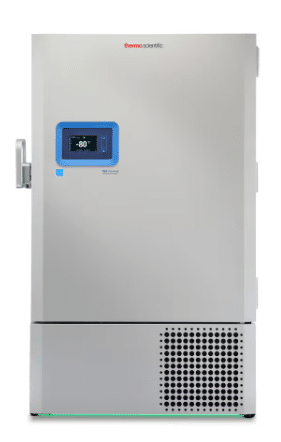

Thermo Scientific™ TSX Universal Series Ultra-Low Temperature Freezers (-80°C)
Models included: TSX Universal Series Upright Freezers (400, 500, 600, 700 Box Capacity Models)
The Thermo Scientific TSX Universal Series ultra-low temperature (ULT) freezers (-80°C) deliver next-generation sample protection, energy efficiency, and operational reliability for critical biological storage. Powered by updated Universal V-drive adaptive technology, the TSX Series dynamically adjusts compressor speeds based on laboratory usage patterns and door openings. Delivering 33% energy savings, 52% faster door-opening recovery, and quiet operation below 44 dB, it features an upgraded interactive touchscreen interface and universal voltage (100–230V) to support biobanking, clinical research, and biopharmaceutical workflows.
Technological Innovations & Core Capabilities
- Universal V-Drive Adaptive Cooling: Next-gen variable-speed compressors deliver 52% faster door-open recovery and up to 38% tighter thermal uniformity throughout the cabinet.
- Outstanding Energy & Environmental Efficiency: ENERGY STAR certified and ACT-labeled design using natural hydrocarbon refrigerants, consuming 33% less energy than legacy TSX models.
- Rapid Sample Access: Active pressure equalization port enables door re-entry in just 30 seconds (57% faster than previous models).
- High-Capacity & Secure Storage: Accommodates from 400 up to 700+ two-inch box capacities with insulated inner doors to prevent cold air loss during access.
- Interactive 7-Inch Touchscreen & Logging: Full-color interface featuring real-time parameter tracking, up to 15 years of event/temperature logging, user access controls, and USB/PoE data connectivity.
- Universal Voltage & Expanded Setpoints: Runs on universal voltage (100–230V, 50/60 Hz) with an expanded setpoint range from -40°C to -86°C.
Intended Applications
- Biobanking & Repository Management: Long-term archival of human biological specimens, genomic libraries, and clinical trial samples under strict thermal stability.
- Biopharmaceutical R&D & Production: Secure storage of temperature-sensitive biologics, vaccines, enzymes, and active pharmaceutical ingredients (APIs).
- Clinical & Diagnostic Laboratories: High-security storage of diagnostic specimens, patient blood derivatives, and pathology reagents requiring reliable -80°C preservation.


Thermo Scientific™ Solaris™ 6000 Stackable Orbital Shaker
Models included: Solaris 6000 Incubated | Solaris 6000 Incubated-Refrigerated
The Thermo Scientific™ Solaris™ 6000 stackable orbital shaker combines flexible incubation and precise continuous orbital shaking in a heavy-duty, space-saving design. Engineered for demanding bioprocessing, cell culture, and microbial workflows, the Solaris™ 6000 supports maximum flexibility with a stackable two-high footprint, two adjustable internal shelves, and a heavy-duty tri-eccentric drive built for loads up to 32 kg (70 lbs). Featuring intuitive color touchscreen controls, broad temperature ranges (Ambient +10°C to 70°C for incubated models; Ambient -15°C to 65°C for refrigerated models), and eco-friendly Peltier cooling, it delivers uncompromised temperature uniformity and 24/7 operational reliability.
Technological Innovations & Core Capabilities
- Heavy-Duty Tri-Eccentric Drive: Built for continuous 24/7 operation and smooth orbital shaking (15-525 rpm) under heavy vessel loads up to 32 kg (70 lbs).
- Energy-Efficient Peltier Refrigeration: Refrigerated models utilize solid-state Peltier technology, consuming 58% less energy than compressor systems.
- Space-Saving Stackable Design: Units stack two-high to double laboratory throughput without expanding the floor footprint.
- Integrated Multi-Shelf Chamber: Spacious stainless steel interior includes an 18″ x 18″ platform and two adjustable shelves for static incubation alongside active shaking.
- Smart Color Touchscreen: Intuitive digital interface featuring protocol storage, parameter graphing, user access controls, and a built-in orbital speed calculator.
Intended Applications
- Bioprocessing & Scale-Up Development: High-capacity microbial fermentation, protein expression, and vector production in cell and gene therapy protocols.
- Cell Culture & Microbiology: Versatile incubation and shaking of bacterial, yeast, and cell cultures in Erlenmeyer flasks, Fernbach vessels, and media bottles.
- Molecular Biology & Screening: High-throughput mixing, staining, and assay incubation utilizing microplates, deep-well plates, and test tube racks.
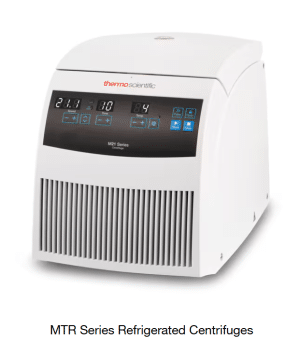

Thermo Scientific™ M Series Microcentrifuges
Models included: MT17 / MT17R (Standard Speed) | MT21 / MT21R (High Speed)
Designed to support the pace and precision of modern laboratories, the Thermo Scientific M Series microcentrifuges deliver powerful micro-volume performance in a compact footprint. Delivering speeds up to 21,100 x g (MT21) or 17,000 x g (MT17), the M Series accommodates versatile tube capacities from standard 1.5/2.0 mL microcentrifuge tubes and 0.2 mL PCR strips to 5 mL and 10 mL tubes. Fitting easily into clinical diagnostic, molecular biology, and life science workflows, it stands out for its operational reliability, safety, and ease of use. Featuring versatile rotor configurations, rapid acceleration and deceleration, and eco-friendly GreenCool refrigeration technology in refrigerated models, it streamlines daily sample processing.
Technological Innovations & Core Capabilities
- Two Speed Performance Tiers: Select between 17,000 x g (MT17 Series) for routine micro-volume separations and up to 21,100 x g (MT21 Series) for demanding molecular protocols.
- High-Capacity & Versatile Rotor Options: Choose from seven optional rotors accommodating 1.5/2.0 mL microcentrifuge tubes, 0.2 mL PCR strips, 5 mL and 10 mL tubes or vessels, or specialized hematocrit capillaries.
- Dual-Row Rotor Efficiency: Innovative dual-row rotor options (24 x 1.5/2.0 mL + 18 x 0.2/0.5 mL) eliminate the need for tube adapters altogether during micro-volume processing.
- Eco-Friendly GreenCool™ Technology: Refrigerated models feature a next-generation natural refrigerant cooling system for enhanced sustainability and rapid thermal recovery.
- Ergonomic & Intuitive Control: Fast one-click™ centrifuge lid closure, easy-to-read displays, and intuitive controls simplify daily operations.
- Lightweight Polymer Rotors: Lightweight engineered polymer rotors deliver outstanding corrosion resistance, complemented by ergonomic one-click™ rotor opening and closing.
- Enhanced Operational Safety: Transparent rotor design enhances safety, supported by certified Thermo Scientific ClickSeal™ biocontainment lids.
- Regulatory Certifications: Available in IVD / IVD-MD models approved for use in clinical diagnostic applications, as well as General Use configurations.
Intended Applications
- Molecular Biology & Genomics: High-speed DNA/RNA extraction, spin-column nucleic acid isolation, and high-throughput PCR strip processing at up to 21,100 x g.
- Clinical Diagnostics & Pathology: Processing of micro-volume blood collection tubes, 5 mL / 10 mL analytical tubes or vessels, serum/plasma separation, and specialized hematocrit determination under IVD compliance.
- Biochemistry & Cell Biology: Protein precipitation, cell debris pelleting, and routine micro-tube spin-downs across various tube formats.

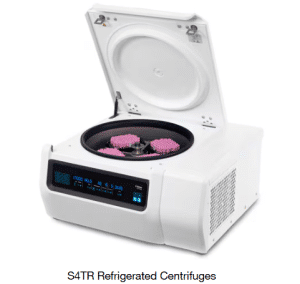
Thermo Scientific™ S4 Series Centrifuges
Models included: S4T (Ventilated Benchtop) | S4TR (Refrigerated Benchtop) | S4FR (Refrigerated Floor-Standing)
The Thermo Scientific S4 Series centrifuges provide high-capacity, heavy-duty sample separation for high-throughput clinical diagnostic laboratories, cell culture facilities, and bioprocessing centers. Supporting swing-out capacities up to 4 x 1,000 mL (4 Liters) and speeds up to 25,830 x g, the S4 Series combines quiet operation with eco-friendly GreenCool refrigeration technology. Manufactured in a certified zero-waste facility in Germany, it delivers sustainable, high-capacity productivity while ensuring rigorous sample protection and temperature stability.
Technological Innovations & Core Capabilities
- Auto-Lock™ Rotor Exchange: Fast, push-button, tool-free rotor installation supporting up to 13 application-specific rotors for seamless workflow transitions.
- GreenCool™ Natural Refrigerant: Advanced R290 cooling system featuring a Global Warming Potential (GWP) of just 3, zero ozone depletion, and reduced energy consumption (S4TR / S4FR).
- High-Capacity Ergonomics: Accommodates up to 4 Liters of sample volume in both space-saving benchtop and floor-standing (S4FR) footprints designed to optimize bench space.
- ClickSeal™ Biocontainment Lids: Certified glove-friendly, one-handed aerosol-tight sealing system for hazardous biological samples and clinical materials.
- Dual Regulatory Certifications: Available in IVD-MD (EU IVDR Class A / FDA Listed Class 1) for regulated diagnostic centers and General Use configurations for research.
Intended Applications
- Clinical Diagnostics: High-volume processing of primary blood collection tubes and diagnostic samples under IVD compliance.
- Cell Culture & Bioprocessing: Large-volume harvesting, cell pelleting, and media separation in 15 mL, 50 mL, and 250 mL/500 mL/1,000 mL vessels.
- Genomics & Proteomics: High-speed separation for spin-column purification, multi-well microplates, and high-density cell lysates.

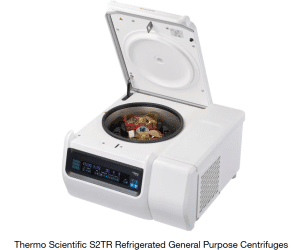
Thermo Scientific™ S2 Series Benchtop Centrifuges
Models included: S2T (Ventilated Benchtop) | S2TR (Refrigerated Benchtop)
The Thermo Scientific S2 Series centrifuges provide exceptional performance, efficiency, and versatility for mid-capacity sample processing in clinical diagnostics and research laboratories. Supporting swing-out capacities up to 4 x 400 mL and speeds up to 25,830 x g, the S2 Series combines an ultra-quiet design with eco-friendly GreenCool technology. Manufactured in a certified zero-waste facility in Germany, it delivers sustainable operations without compromising cooling speed or sample protection.
Technological Innovations & Core Capabilities
-
Auto-Lock™ Rotor Exchange: Quick, push-button, tool-free rotor swapping supporting up to 15 application-specific rotors.
-
GreenCool™ Natural Refrigerant: Next-generation R290 cooling system with a Global Warming Potential (GWP) of just 3, zero ozone depletion, and up to 15% energy savings compared to previous generations (S2TR).
-
Ultra-Quiet & Ergonomic: Class-leading low noise operation (below 42 dB(A) for ventilated S2T models and below 52 dB(A) for refrigerated S2TR models) engineered to enhance laboratory working environments.
-
ClickSeal™ Biocontainment Lids: Glove-friendly, aerosol-tight sealing system certified for safe handling of clinical or hazardous samples.
-
Dual Regulatory Certifications: Available in IVD-MD (EU IVDR Class A / FDA Listed Class 1) for diagnostic applications and General Use configurations.
Intended Applications
-
Clinical Diagnostics & Pathology: Medium-throughput processing of primary blood collection tubes and urine containers under strict IVD regulatory standards.
-
Cell Culture & Sample Prep: Gentle pelleting and washing of cell suspensions in 15 mL and 50 mL conical tubes.
-
Genomics & Proteomics: High-speed centrifugation for microplate purification, spin-column nucleic acid extraction, and protein work.
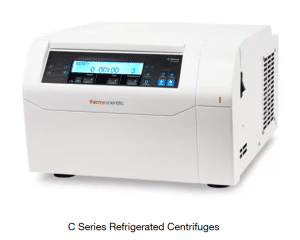

Thermo Scientific™ C Series Compact Centrifuges
Models included: C1T (Ventilated Benchtop) | C1TR (Refrigerated Benchtop) | C1FR (Refrigerated Floor-Standing)
The Thermo Scientific™ C1 Series centrifuges deliver high-capacity sample separation in an exceptionally compact footprint, designed specifically for clinical diagnostics and life science research laboratories where space, speed, and sample integrity are critical. Offering up to 4 x 145 mL swing-out capacity and speeds up to 30,279 x g, the C1 Series seamlessly bridges routine blood/urine processing with advanced cellular and molecular workflows, combining eco-friendly GreenCool™ technology with certified biocontainment protection.
Technological Innovations & Core Capabilities
-
Auto-Lock™ Rotor Exchange: A tool-free, push-button rotor exchange mechanism that allows operators to switch between swinging-bucket and high-speed fixed-angle rotors in seconds, ensuring maximum versatility across multi-user environments.
-
GreenCool™ Natural Refrigerant Technology (C1TR / C1FR): Powered by R290 natural hydrocarbon refrigerant, achieving a Global Warming Potential (GWP) of just 3. This system reduces power consumption by up to 15.7% compared to previous generations while eliminating harmful PFAS environmental byproducts.
-
ClickSeal™ Biocontainment Lids: Certified glove-friendly, one-handed biocontainment sealing system that provides verified aerosol protection for hazardous or clinical samples.
-
Dual Compliance & Certification: Available in both IVD-MD (EU IVDR Class A / FDA Listed Class 1) for regulated diagnostic laboratories and General Use configurations for academic and industrial R&D.
-
Space-Optimized Ergonomics: Engineered to maximize bench space without compromising sample capacity, with an available floor-standing model (C1FR) for labs seeking to free up critical workspace entirely.
Intended Applications
-
Clinical Diagnostics & Pathology: High-throughput processing of blood collection tubes (5/7 mL, 10/12 mL) and urine tubes for hematology, immunology, and clinical chemistry.
-
Cell Culture & Sample Preparation: Low-speed, gentle pelleting of mammalian, mammalian cell lines, and primary cells in 15 mL and 50 mL conical tubes.
-
Molecular Biology & Genomics: Nucleic acid cleanup, plasmid isolation, and protein precipitation, supporting both high-capacity conical tubes and optional spin-column MicroClick™ rotors.
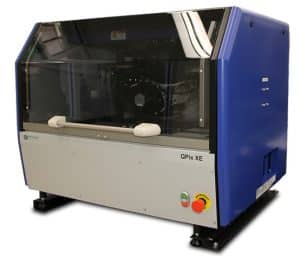
QPix® XE Compact Automated Colony Picker
The QPix® XE system is a compact, automated solution designed for efficient microbial colony picking, tailored specifically for laboratories with limited space or targeted application requirements. Engineered to replace highly subjective and error-prone manual picking workflows with precision automation, it serves as an ideal entry-level system within the QPix portfolio. The system delivers reliable screening and selection capabilities while maintaining a minimal laboratory benchtop presence.
Target Applications
-
Standard Molecular Cloning & Plasmid Preparation: Replaces repetitive manual picking with consistent automation, minimizing human error and standardizing workflows for smaller research setups.
-
Academic & Routine Microorganism Selection: Provides core automated colony recovery for academic labs and specialized research facilities looking to transition away from manual colony management.
-
Targeted Library Management: Enables accurate selection and transfer of target clones from mixed cultures into standard destination formats for downstream evaluation.
Key Capabilities & System Advantages
-
Space-Saving Benchtop Design: Features a minimal and highly compact physical footprint, making it perfectly suited for smaller laboratories or facilities where workspace optimization is critical.
-
Accurate Colony Selection: Equipped with advanced imaging technology to ensure objective and precise picking, eliminating the human bias and variation associated with manual selection.
-
User-Friendly Operation: Simplifies the entire automated colony picking process through an intuitive and easy-to-use software interface, facilitating fast setup and routine walkaway operation.
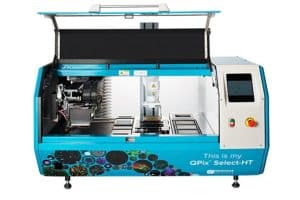
QPix® HT High-Throughput Microbial Colony Picking System
The QPix® HT High-Throughput Microbial Colony Picking System is a fully automated, industrial-scale robotic workcell engineered to provide the highest level of flexibility, throughput, and walkaway time within the QPix portfolio. Designed to handle large-scale workflows and library management, it offers advanced modular integration with robotics to eliminate repetitive, time-consuming tasks. The system enables robust, automated screening and selective transfer of microbial colonies with continuous, clear record tracking across complex multi-format experiments.
Target Applications
-
High-Throughput Transformation & Library Management: Automates large-scale genetic library management, pooled library setups, and high-volume clone selection post-transformation.
-
Industrial Microbial Strain Engineering: Enables rapid identification, screening, and phenotypic tracking of vast microorganism variant libraries to isolate top-producing production strains.
-
Antibody Discovery & Phage Screening: Accelerates antigen-antibody screening cycles by expanding the volume of variant screening arrays to increase the probability of capturing high-affinity binders.
-
Molecular Cloning at Scale: Standardizes the iterative process of transforming, plating, streaking, and tracking to support continuous operation in high-volume sequencing facilities and biotech platforms.
-
Synthetic Biology & Biofuels Development: Integrates seamlessly into design-build-test-learn bioeconomy engineering pipelines that rely on high-capacity automated biofoundry workflows.
Key Capabilities & System Advantages
-
Industrial Scale Automation: Configured as a fully modular system ready for integration with third-party robotics and liquid-handling automation platforms to maximize laboratory efficiency and continuous performance.
-
Massive Screening Capacity: Screens up to 30,000 colonies per day, delivering high-throughput execution designed for research institutes, pharmaceutical companies, and automated sequencing hubs.
-
Flexible Bed Setup: Supports multiple configurations of source and destination plate formats simultaneously, allowing complex replication, rearraying, and library arrays across a broad laboratory workspace.
-
Automated Labware Handling: Features automated plate de-lidding mechanisms to automatically manage contamination controls and preserve environmental sterility during walkaway runs.
-
Acoustic Agar Sensing Height Technology: Incorporates integrated acoustic sensor systems that map agar height variations across source trays, permitting high-precision robotics to execute gentle, single-colony pick-ups without disrupting the growth media.
-
Comprehensive Sample Traceability: Utilizes an integrated barcode reader that scans and links source plates to target plates, securing data tracking, layout histories, and error-free experimental logs.
-
Advanced Multi-Modal Imaging Mode: Leverages analytical imaging algorithms to screen, identify, and select individual clones objectively based on white light and selectable multi-channel fluorescence criteria.
-
Interchangeable Picking Heads: Accommodates interchangeable, organism-specific picking heads to process diverse target populations, including E. coli, phage, and yeast on a single platform.
-
Rigorous Thermal Sterilization Control: Integrates dedicated multi-stage pin wash baths with a proprietary halogen heat sterilization station to eliminate cross-contamination among picking pins.
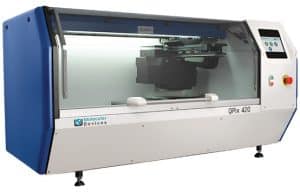
QPix® 420 Microbial Colony Picker
The QPix® 420 Microbial Colony Picker is a robust, high-throughput automated system designed to replace manual workflows and scale microbial screening with greater precision and walkaway time. As a flexible, upgradeable workhorse within the QPix portfolio, it supports advanced multi-modal imaging, diverse screening applications, and seamless future integration into automated robotic workflows. The system significantly reduces laboratory labor and time while tracking comprehensive data from start to finish to ensure complete reproducibility.
Target Applications
-
Protein Engineering & Mutation Screening: Accelerates the throughput of screened variants by allowing users to navigate richer genetic libraries and rapidly select mutants with desired traits.
-
Molecular Cloning & Plasmid Production: Automates the laborious and repetitive processes of cell spreading, plating, streaking, and colony recovery to eliminate human error and speed up downstream analysis.
-
Microbial Strain Engineering: Identifies and selects high-producing engineered microorganisms from large libraries using customizable phenotypic selection parameters.
-
Antibody Discovery & Phage Display: Increases the screening throughput of antigen-antibody interactions to optimize the identification of high-affinity binders.
-
Gene Editing (CRISPR/Cas9): Enables large-scale library management, pooled library picking, and hit picking into high-throughput microtiter plate screening workflows.
Key Capabilities & System Advantages
-
High-Throughput Automation & Walkaway Time: Screens and picks up to 3,000 colonies per hour with greater than 95% picking accuracy. The system increases laboratory autonomy by handling up to 12 standard 96-well destination plates before requiring manual intervention.
-
Multi-Modal Imaging guided Selection: Supports advanced white light trans-illumination and optional multi-channel epifluorescence imaging. Five standard wavelengths are available (supporting DAPI/Hoechst, FITC/GFP, Cy3/DS Red, Cy5, and Rhodamine/Texas Red) to automatically image and select clones based on target intensity.
-
Versatile Process Automation: Performs multiple mechanical operations beyond standard colony picking, including liquid-to-liquid plate replication, gridding, rearraying, hit picking, and structural plate compression or expansion across 96- and 384-well formats.
-
Advanced Colony Screening Parameters: Utilizes objective software algorithms to allow precise, automated colony identification and selection based on defined structural traits such as size, proximity, roundness, blue-white screening, and zone of inhibition assays.
-
Integrated Data Tracking & Traceability: Equipped with a built-in barcode reader that automatically scans and links source and destination plates, maintaining a continuous audit trail and clear record of experimental data.
-
Acoustic Agar Height Sensing: Utilizes integrated sensor technology to detect variations in agar surface height resulting from pouring volume differences, adjusting robotic z-axis travel to ensure gentle, accurate colony pick-ups without disrupting the media.
-
Rigorous Cross-Contamination Control: Combines automated UV interior sanitization with multi-stage pin washing static baths and a proprietary halogen heat sterilization station to eliminate microbial carryover between picks.
-
Flexible Deck & Organism-Specific Heads: Supports an adaptable deck layout accommodating 15 cm and 9 cm petri dishes, OmniTrays, and QTrays. Features interchangeable picking heads with organism-specific pins engineered for different targets including E. coli, phage, and yeast.
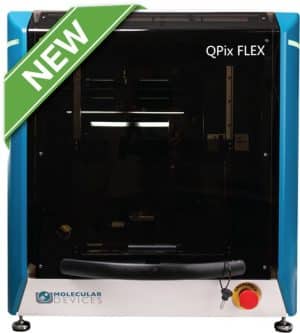
QPix® FLEX™ Microbial Colony Picking System
The QPix FLEX™ Microbial Colony Picking System is an integrated, automated benchtop workcell engineered to streamline and standardize the entire microbial cell line development workflow. Purpose-built to eliminate manual variability, fragmentation, and contamination risks, the system consolidates automated agar plating, streaking, colony picking, and liquid handling into a single, space-saving instrument. It achieves a documented baseline of over 95% picking efficiency, 99% picking accuracy, and 0% cross-contamination in validated screening protocols.
Target Applications
-
Microbiome Research & Anaerobic Microbiology: Optimized for fastidious or rare anaerobic microbial communities requiring sterile technique, precise colony isolation, and direct compatibility within standard hypoxic/anaerobic chambers.
-
Synthetic Biology & Plasmid Production: High-throughput automated colony recovery and hit picking post-transformation to accelerate discovery, validation, and preparation cycles.
-
Protein & Enzyme Engineering: Automated library screening of variants for downstream parallel analysis, correlating visible phenotype traits with early expression output.
-
Microbial Strain Engineering: Rapid selection and differentiation of top-producing strains from large mutagenic libraries based on subtle phenotypic criteria such as size, shape, proximity, and color.
-
Food Safety & Environmental QC: Automated pathogen screening and isolation (e.g., E. coli, Salmonella, Listeria) using selective media grouping to shorten turnaround times.
-
Natural Product & Pigment Discovery: Phenotype-driven isolation of target strains through automated colorimetric identification of metabolic pigments, allowing researchers to group and rank unique colonies early in the workflow.
Key Capabilities & System Advantages
-
Hypoxic and Anaerobic Chamber Integration: Sized and structurally configured with a compact footprint to operate natively inside standard low-oxygen and anaerobic environments where traditional automation systems fail to function.
-
Phenotype-Based Colony Selection: Equipped with a 20-megapixel CMOS high-resolution color camera and white light trans-illumination system to classify, group, and rank target colonies based on precise color, morphology, size, shape, and proximity criteria.
-
Multi-Function 4-Channel Pipetting Head: Eliminates independent fluid-handling steps by automating complex liquid transfers, media dispensing, glycerol addition, agar plating, and hit picking within the same instrument without needing additional hardware.
-
Swappable Tip System: Allows hardware-free switching between eco-friendly, reusable sterilizable metal picking pins and disposable plastic filter tips (supporting 50 uL, 200 uL, and 1000 uL volumes) to easily tailor operations to specific workflow budgets or sterility controls.
-
Comprehensive Sample Traceability: Features an integrated 2D barcode reader that links and tracks every plate and pick from source to destination, maintaining complete audit trails and data integrity.
-
Precision Mechanical Reliability: Utilizes an ultrasonic agar height sensor to detect pouring volume variations across agar surfaces, automatically modulating robotic movement to guarantee gentle, repeatable colony pick-ups.
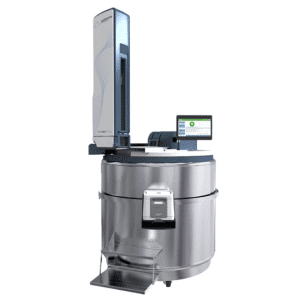
CryoArc™ Tera & Tera for Cassettes Automated Cryogenic Storage System
The CryoArc™ Tera platform represents a high-capacity, fully automated liquid nitrogen vapor-phase storage solution built to consolidate large sample collections down to a uniform -190°C baseline environment. Optimized for enterprise-scale operations, the system integrates advanced robotics with comprehensive inventory control to eliminate manual rack lifting and safeguard biological assets from accidental thermal exposures above the water glass transition boundary (Tg -135°C).
The platform is deployable across two core configurations: the standard CryoArc™ Tera layout optimized for standard cryobox racking, and the specialized CryoArc™ Tera for Cassettes framework. The specialized Cassette configuration integrates dedicated mechanical sub-structures designed specifically for advanced cell and gene therapy (CGT) manufacturing lines and high-throughput cleanrooms, processing exactly one clinical lot at a time to shield adjacent materials from ambient exposure.
Key Advantages
-
Thermal Exposure Mitigation: Automated single-container retrieval mechanisms isolate transactions, preventing non-targeted innocent samples from undergoing transient warming events.
-
Footprint Optimization: Maximizes vertical and physical facility space to enable ultra-high-density storage within a single consolidated footprint.
-
Rigorous Integrity Control: Standardizes handling operations, eliminates physical operator exposure to cryogenic hazards, and enforces total chain-of-custody data verification.
Ideal Applications
-
National biorepositories, global pharmaceutical research hubs, and large-scale genetic banks
-
Commercial Cell & Gene Therapy (CGT) cleanrooms and advanced therapy manufacturing centers
-
High-throughput clinical trial repositories and industrial master cell banks (MCB)
Robotic Automation & Labware Handling
-
Insulating Tower Architecture: Internal engineering incorporates an insulated vertical handling tower that acts as a thermal barrier, maintaining internal sample temperatures even during vertical movement cycles.
-
Single-Cassette Processing Core: The specialized Tera for Cassettes mechanics handle exactly one container element independently, ensuring adjacent packages remain undisturbed inside the baseline cryogenic environment during inventory management routines.
-
High-Speed Execution Turnaround: Robotic container retrieval execution is completed in less than 60 seconds to secure continuous cold chain infrastructure continuity.
Integrated Software & Regulatory Compliance
-
Integrated CryoArc Software Platform: Tracks individual sample location, sample movement parameters, and user access metrics across the sample’s operational lifetime.
-
Real-Time Telemetry Logging: Captures critical environmental data, including internal temperature uniformity, unexpected system events, operational alarms, liquid nitrogen levels, and nominal LN2 usage rates.
-
Enterprise LIMS Connectivity: Employs an optional WebAPI module to seamlessly integrate tracking telemetry with homegrown or enterprise Laboratory Information Management Systems (LIMS).
-
Audit Trail Generation: Fully supports adherence to FDA 21 CFR Part 11 compliance standards. All sample history, user validation logs, and performance parameters can be downloaded in a standardized format for immediate inclusion in official audit reports.
-
Electronic Quarantine Controls: Software-enabled electronic quarantine functionality permits administrators to flag, isolate, and restrict access to specific containers within the automated framework.
Infrastructure Redundancy & Disaster Protection
-
Extended Hold Time Stability: Provides up to 21 days (Standard Tera configuration) or up to 23 days (Specialized Cassette layout) of continuous static temperature stability to protect stored biological assets during total facility electrical outages or liquid nitrogen supply interruptions.
-
Onboard Integrated UPS: Features an onboard uninterruptible power supply (UPS) to sustain the software storage environment, internal telemetry data collection, and system monitoring parameters during sudden power disruptions.
Technical Specifications
Storage Capacity (Standard Tera Layout): Accommodates 630 x 2” standard laboratory cryoboxes (or equivalent), supporting mix-and-match configurations of cryovials and cassettes
Storage Capacity (Specialized Cassette Layout): Configured to store up to 990 large 250ml scale cryo cassettes
Operating Temperature Baseline: -190°C (Liquid Nitrogen Vapor Phase environment)
Emergency Static Holding Time: 21 to 23 days to maintain a baseline of -135°C (configuration dependent)
System Physical Dimensions (H x W x D): 125.10″ x 60.00″ x 79.00″ (3,179 mm x 1,524 mm x 2,007 mm)
System Structural Weight (Standard Tera): 2,237 lbs (1,016 kg) Empty / 3,582 lbs (1,627 kg) Full Estimated Baseline
System Structural Weight (Cassette Layout): 2,231 lbs (1,054 kg) Empty / 3,441 lbs (1,563 kg) Full Estimated Baseline
Maximum Structural Floor Load (Standard Tera): 109 lbs/ft² (533 kg/m²)
Maximum Structural Floor Load (Cassette Layout): 105 lbs/ft² (512 kg/m²)
Electrical Input Parameters: 110V / 220V, Single Phase
System Power Consumption Metrics: 100 Watts (Idle) / 220 Watts (Maximum output)
LN2 Supply Line Interface: 1/2″ NPT Male Fitting to existing LN2 Supply Line
LN2 Operational Supply Pressure: 22-35 psig (1.52 – 2.41 bar) under open valve workflow
LN2 Evaporation Rate (Nominal): Approximately 13.6 Liters per day
Operating Environment Limits: Temperature: 18°C – 27°C (65°F – 80°F) | Humidity: Maximum 50% rH (non-condensing)
Regulatory & Compliance Index: CE Mark Directives, China RoHS, Conflict Materials, EU REACH, EU RoHS
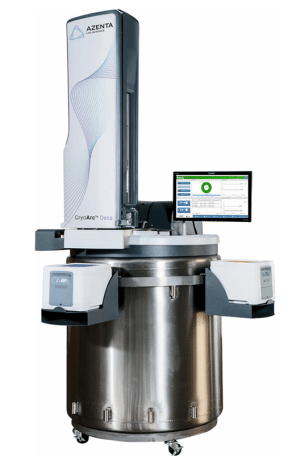
CryoArc™ Deca -190°C LN2-Based Automated Storage System
The CryoArc™ Deca Automated LN2-Based Storage System is a medium-to-large automated biorepository platform engineered to safeguard fragile cellular structures and temperature-sensitive biological products. Optimized for institutional biobanks, biotechnology research environments, and clinical-scale biorepositories, the system integrates advanced robotics with comprehensive inventory control.
The system utilizes liquid nitrogen vapor phase technology to maintain a complete and uniform -190°C cryogenic storage environment across the entire internal chamber. By implementing computer-controlled robotic handling, it isolates non-targeted samples during routine retrieval sequences, protecting “innocent samples” from unintended transient warming events and hazardous thermal fluctuations above the water glass transition temperature (Tg -135°C).
Key Advantages
-
Thermal Exposure Mitigation: Automated sample transactions minimize ambient exposure, shielding non-targeted cryovials from transient warming cycles.
-
Footprint Optimization: Offers high internal storage capacity and mixed-labware density within a standardized facility floor space allotment.
-
Rigorous Integrity Control: Delivers precise process control, automated structural insulation, and absolute chain-of-custody tracking for critical biological assets.
Ideal Applications
-
Medium-to-large institutional biobanks and biorepositories
-
Pharmaceutical and biotechnology research laboratories
-
Clinical research facilities and centralized cell repositories
Robotic Automation & Labware Handling
-
Convective Thermal Sleeve Engineering: The internal mechanics feature structural storage racks wrapped in an engineered insulating sleeve. This configuration blocks convective air currents during vertical rack lifts, keeping unrequested internal samples up to 20°C colder during routine box transactions compared to uninsulated tanks.
-
Versatile Labware Accommodations: The automated robotic tower executes precise transactions at the box, SBS rack, and cassette level, supporting cryogenic storage cassettes up to 50 mL volumes.
-
High-Speed Execution Turnaround: Box-level retrieval cycle execution is completed in less than 60 seconds to secure continuous cold chain infrastructure.
Integrated Software & Regulatory Compliance
-
Integrated CryoArc Software Platform: Tracks individual sample location, sample movement parameters, and user access metrics across the sample’s operational lifetime.
-
Real-Time Telemetry Logging: Captures critical environmental data, including internal temperature uniformity, unexpected system events, operational alarms, liquid nitrogen levels, and nominal LN2 usage rates.
-
Enterprise LIMS Connectivity: Employs an optional WebAPI module to seamlessly integrate tracking telemetry with homegrown or enterprise Laboratory Information Management Systems (LIMS).
-
Audit Trail Generation: Fully supports adherence to FDA 21 CFR Part 11 compliance standards. All sample history, user validation logs, and performance parameters can be downloaded in a standardized format for immediate inclusion in official audit reports.
Infrastructure Redundancy & Disaster Protection
-
Extended Hold Time Stability: Provides up to 15 days of continuous static temperature stability to protect stored biological assets during total facility electrical outages or liquid nitrogen supply interruptions.
-
Onboard Integrated UPS: Features an onboard uninterruptible power supply (UPS) to sustain the software storage environment, internal telemetry data collection, and system monitoring parameters during sudden power disruptions.
Technical Specifications
Storage Capacity (Vials): Stores up to 52,136 x 1.0ml Azenta cryotubes OR 26,600 x 2.0ml Azenta cryotubes
Storage Capacity (Boxes/Cassettes): Accommodates 266 x 2” Cryoboxes (or equivalent), 1,520 x 25ml cassettes, OR 760 x 50ml cassettes
Operating Temperature Baseline: -190°C (Liquid Nitrogen Vapor Phase environment)
Emergency Static Holding Time: 15 days to maintain a baseline of -135°C
System Physical Dimensions (H x W x D): 107.9″ x 45.8″ x 58.9″ (2,741 mm x 1,163 mm x 1,496 mm)
System Structural Weight: 1,497 lbs (680 kg) Empty / 2,155 lbs (979 kg) Full Estimated Baseline
Maximum Structural Floor Load: 116 lbs/ft² (563 kg/m²)
Electrical Input Parameters: 110V / 220V, Single Phase
System Power Consumption Metrics: 100 Watts (Idle) / 220 Watts (Maximum output)
LN2 Supply Line Interface: 1/2″ NPT Male Fitting to existing LN2 Supply Line
LN2 Operational Supply Pressure: 22-35 psig (1.52 – 2.41 bar) under open valve workflow
LN2 Evaporation Rate (Nominal): Approximately 9.9 Liters per day
Operating Environment Limits: Temperature: 18°C – 27°C (65°F – 80°F) | Humidity: Maximum 50% rH (non-condensing)
Regulatory & Compliance Index: CE Mark Directives, China RoHS, Conflict Materials, EU REACH, EU RoHS
