

KNOWLEDGE CENTER
From DNA Construction to Protein in 1 Day
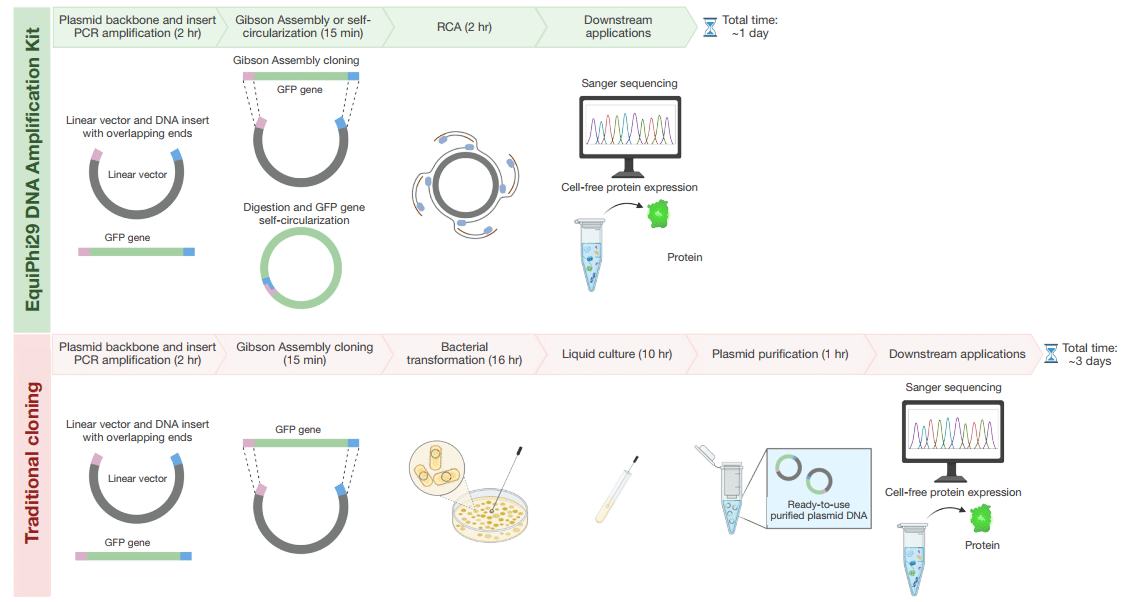
Figure 1. Comparison of total reaction time using a combination of Gibson Assembly cloning or self-circularization and RCA versus the traditional cloning approach. The cell-free workflow reduces experimental time from ~3 days to ~1 day by omitting time-consuming bacterial transformation, liquid culture, and plasmid purification steps and replacing them with a fast, efficient RCA reaction.
Cloning genes and expressing the corresponding proteins is traditionally a multiday, labor-intensive process that relies on living prokaryotic or eukaryotic cells. Yes, it is possible to construct a genetic template, amplify it to microgram scale, and express functional protein within a single day. Here is how a streamlined, cell-free workflow makes it happen.
The 1-Day Cell-Free Workflow
Amplify linear vector backbone and DNA insert fragments with overlapping ends by PCR using high-fidelity Platinum™ SuperFi™ II DNA Polymerase.
Link overlapping DNA fragments seamlessly in one isothermal reaction using GeneArt™ Gibson Assembly™ HiFi Master Mix, or self-circularize a digested gene fragment via a 5-minute rapid ligation step (~15 minutes total workflow).
Amplify circular DNA templates directly from the assembly reaction at 42°C using the EquiPhi29™ DNA Amplification Kit to generate up to ~18 µg of DNA.
Use the Rolling Circle Amplification (RCA) products directly for Sanger sequencing and cell-free protein expression (CFPE), omitting transformation and plasmid purification.
Cell-Free Construct Generation and Amplification
Traditional protein expression workflows require at least 2 to 3 days of experimental work. Following PCR amplification and DNA assembly, standard protocols rely on bacterial transformation (16 hours), liquid culture growth (10 hours), and plasmid miniprep purification (1 hour) before downstream applications can begin.
To reduce time and labor, this application note demonstrates a cell-free protocol that combines Gibson Assembly™ cloning or gene-of-interest self-circularization with Rolling Circle Amplification (RCA) and cell-free protein expression (CFPE). Because the product of Gibson Assembly cloning or self-ligation is circular, it can be amplified directly by RCA using a strand-displacing polymerase such as Thermo Scientific™ EquiPhi29™ DNA Polymerase, which generates high yields of long concatemeric products in just 2 hours from a small amount of template.
Key Findings from the Application Note
- Direct Amplification Without Template Isolation: EquiPhi29™ DNA Polymerase amplifies DNA directly from Gibson Assembly cloning or self-circularization reaction mixtures without inhibition from side-products, yielding up to ~18 µg of DNA in 2 hours.
- 15-Minute Gibson Assembly Reaction: Time-course evaluations (15, 30, or 45 minutes at 50°C) demonstrated similar CFU counts and RCA yields across all time points, with 100% insert verification (14/14 screened clones per time point) and sequence confirmation (15/15 analyzed clones).
- Self-Circularization Without a Vector Backbone: Alternatively, a gene of interest containing regulatory sequences (promoter, ribosome-binding site, terminator) can be restriction-digested and self-ligated in a 5-minute ligation reaction at 20°C using the Thermo Scientific™ Rapid DNA Ligation Kit, simplifying high-throughput variant selection and reducing costs.
- High-Quality Sequencing and Cell-Free Protein Expression: 20x-diluted RCA products generated high-quality Sanger sequencing chromatograms (924 to 1,027 nt trace lengths, comparable to 1,030 nt for purified plasmid control) and enabled cell-free GFP synthesis as efficiently as, or better than, purified plasmid DNA.
For detailed methods, reaction setups, and experimental data, download the full Thermo Fisher Scientific application note.
Key Enzymes for Rapid Isothermal Amplification and Assembly
Isothermal amplification methods offer fast and efficient nucleic acid amplification at a constant temperature without relying on thermocycling steps. In this 1-day workflow, two core reagent kits work together to assemble and amplify circular DNA templates directly from linear PCR fragments.
Thermo Scientific™ EquiPhi29™ DNA Amplification Kit
EquiPhi29™ DNA Polymerase is a proprietary phi29 mutant developed through in vitro protein evolution for isothermal Rolling Circle Amplification (RCA) and Multiple Displacement Amplification–Whole Genome Amplification (MDA-WGA) at an elevated reaction temperature of 42°C. Compared to wild-type phi29 polymerase (30°C), it delivers higher yield, faster reaction times, and lower amplification bias across GC-rich targets.
- Optimal Reaction Temperature: 42°C (2-hour reaction protocol)
- High Fidelity & Processivity: Strong 3′→5′ exonuclease (proofreading) activity and high processivity (amplifies fragments up to 70 kb)
- Versatile Input Compatibility: Amplifies directly from diluted Gibson Assembly reactions, self-circularization reactions, picked colonies, or purified plasmids without column isolation
- Catalog Reference: Cat. No. A65393 (100 reactions)
Invitrogen™ GeneArt™ Gibson Assembly™ HiFi Master Mix
Enables overlapping DNA fragments of different lengths to be seamlessly linked with no extra sequences or scars in a single isothermal reaction at 50°C in as little as 15 minutes (15–60 minutes depending on fragment number). After a simple 10x dilution, the covalently bound circular product can be used directly as an RCA template without column purification or bacterial transformation.
- Fast Single-Tube Protocol: 15-minute incubation at 50°C for 1–2 fragments (up to 60 minutes for assembling up to 6 fragments, from 500 bp to 32 kb)
- Seamless Multi-Fragment Assembly: Joins overlapping fragments uniformly (tested at a 1:1 molar ratio in this workflow)
- Supporting Workflow Reagents: Combine with Platinum™ SuperFi™ II DNA Polymerase (Cat. No. 12361010) and Rapid DNA Ligation Kit (Cat. No. K1422)
- Catalog Reference: Cat. No. A46628 (50 reactions)
Thermo Fisher Scientific provides a comprehensive portfolio of enzymes and master mixes for isothermal nucleic acid amplification and molecular cloning. Alongside EquiPhi29™ and phi29 DNA Polymerases for Rolling Circle Amplification (RCA) and Whole Genome Amplification (WGA), researchers can access specialized enzymes for Loop-Mediated Isothermal Amplification (LAMP and RT-LAMP), including Bsm DNA Polymerase, Bst DNA Polymerase, and SuperScript™ IV RT-LAMP Master Mix, as well as FastDigest™ restriction enzymes and E-Gel™ EX precast agarose gels.
Your Trusted Lab Benchtop Devices Reimagined
Optimize your molecular biology workflows with the latest benchtop innovations from Thermo Fisher Scientific. Engineered to deliver enhanced performance for PCR amplification, isothermal incubation, and gel electrophoresis analysis, these advanced systems consolidate high-efficiency capabilities into a significantly smaller bench footprint. Benefit from enlarged, high-resolution user interfaces, increased multi-user flexibility, and maximized sample throughput, all with zero alterations to your validated protocols.

Applied Biosystems™ PowerFlex™ Thermal Cycler
Designed to maximize sample throughput and multi-user flexibility while conserving premium bench space with a 20% smaller footprint and a 10.1-inch tilt-adjustable touchscreen.
- Flexible Block Formats: Choose a 3×32-well VeriFlex™ block to run three independent protocols simultaneously, or a 96-well block supporting fully skirted plates for automation integration.
- 7.0°C/sec Block Ramp Rate: Minimizes non-specific priming and artifact amplification, fully unlocking fast PCR master mix performance.
- Strict Thermal Precision: ±0.15°C accuracy (35–99.9°C) and <0.4°C well-to-well uniformity at 95°C (<0.3°C at 72°C) for run-to-run consistency.
- Onboard Simulation Mode: Instantly migrates validated protocols from legacy systems with zero re-optimization required.

Invitrogen™ E-Gel™ Power Snap Lite Electrophoresis System
Consolidates gel running and imaging into a compact 26.0 × 13.0 × 20.0 cm dockable system with an intuitive touchscreen preloaded with preset protocols for consistent, operator-independent runs.
- Buffer-Less Precast Cassettes: Eliminates gel pouring, buffer preparation, and toxic stain handling for immediate, single-step sample loading.
- Direct DNA Recovery: Optimized for routine 11- and 22-well precast formats, including CloneWell™ II and SizeSelect™ II gels to purify DNA directly from the cassette without gel extraction steps.
- Integrated 4 MP Imaging: Built-in 4 MP camera and safe blue-light transilluminator with an amber filter for real-time fragment visualization without DNA damage.

Invitrogen™ iGlow™ Gel Documentation System
A compact, everyday benchtop companion in the iBright™ line, featuring onboard touch-screen image editing and included iBright™ Analysis Software (desktop/cloud) to streamline nucleic acid and protein gel documentation.
- One-Touch Capture & Auto-Exposure: Instantly acquires publication-ready gel images with automatic exposure calculation and onboard editing tools.
- Three LED Light Sources with Auto-Tray Recognition: Automatically detects the inserted tray (UV, Blue, or White) to activate the corresponding LED light source, eliminating manual setup and bulb replacements.
- Safe Blue-Light Gel Excision: Enables real-time band monitoring and cutting without damaging DNA fragments or exposing users to harmful UV radiation.
Ready to Maximize Your Workflow Efficiency?
Contact Rhenium Bio today to schedule a live demonstration of the new benchtop systems or consult with our molecular biology specialists on optimizing your isothermal amplification and cloning protocols.
