

KNOWLEDGE CENTER
Advancing Biobanking Integrity
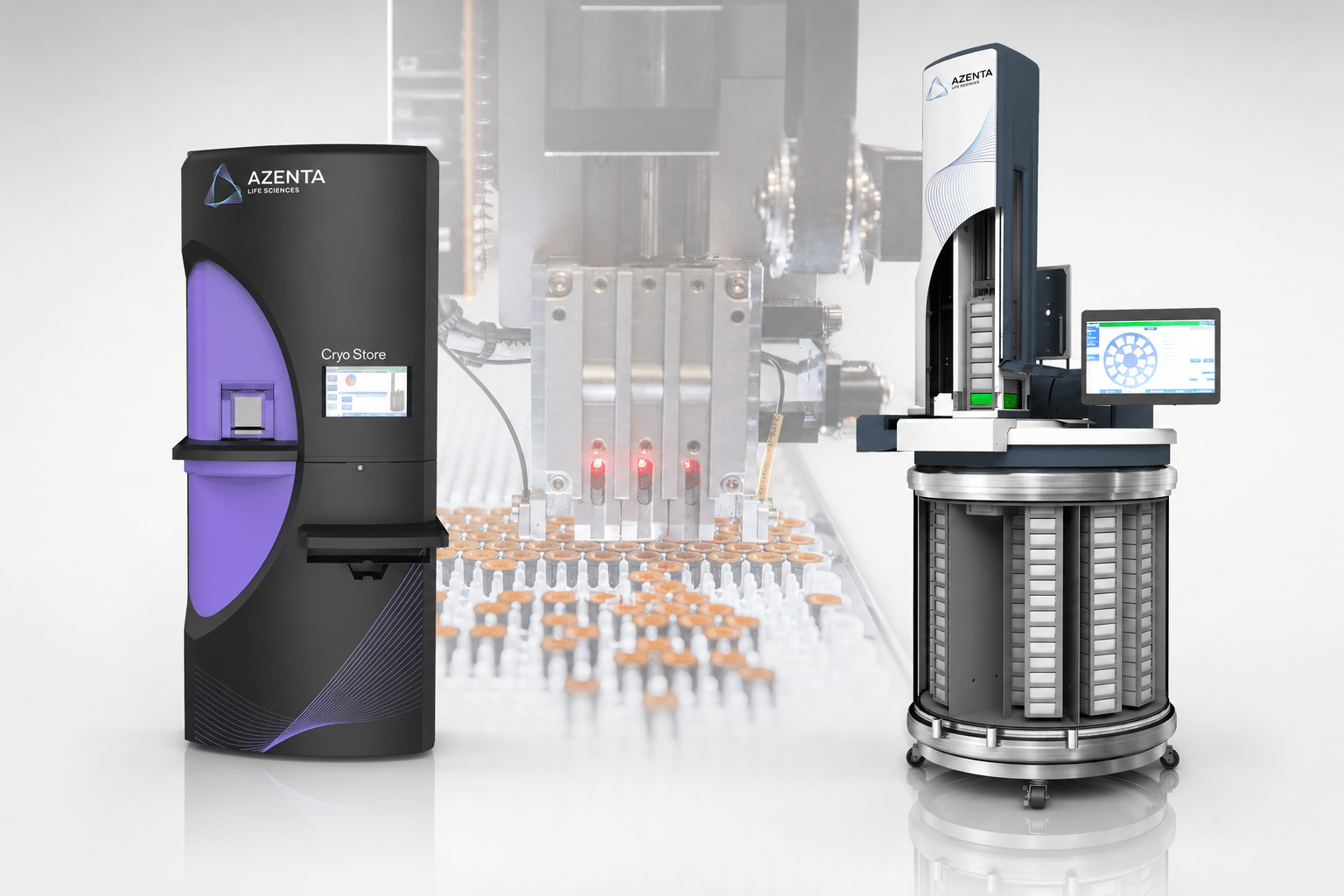
Introduction to Cryogenic Cold Chain Integrity
Modern biomedical research, pharmaceutical manufacturing, and advanced therapeutics, such as autologous and allogeneic cell therapies, rely heavily on the long-term preservation of high-value biological samples. Maintaining maximum sample quality, phenotypic stability, and cellular functionality requires strict environmental uniformity throughout the storage lifecycle.
The primary baseline objective of any cryogenic biorepository is to safeguard sample integrity by keeping biological components continuously below the water glass transition temperature (Tg = -135°C). Below this critical thermal boundary, metabolic processes, enzymatic degradation, and background chemical reactions cease or are reduced to negligible rates, effectively arresting cellular aging.
In full alignment with the International Society for Biological and Environmental Repositories (ISBER Best Practices), modern sample governance mandates the minimization of transient thermal anomalies and the complete documentation of a sample’s thermal history to ensure an unbroken cold chain.
The Thermodynamic Challenge of Transient Warming Events
A critical, often unmeasured challenge in manual inventory management inside conventional liquid nitrogen vapor freezers is the occurrence of Transient Warming Events. When a researcher manually extracts a storage rack to retrieve a specific sample box, thousands of adjacent, non-targeted samples — referred to as “innocent samples” — are inadvertently pulled out into the ambient room environment.
Thermodynamic Excursion Metrics During Manual Workflows
- Rapid Ambient Excursion Rates: Biological samples exposed to ambient room conditions experience a high warming rate, averaging 1.2°C per second when starting from a -180°C baseline.
- The 45-Second Boundary: Due to this high warming velocity, a standard cryovial can cross the critical glass transition zone (Tg = -135°C) in as few as 45 seconds of cumulative room temperature exposure.
- The Innocent Continued Warm-up Phenomenon: Thermocouple data proves that thermal distress does not end when the rack is returned to the freezer. After a manual rack is placed back into the cryogenic environment, the samples continue to absorb ambient heat trapped in the local micro-environment, warming up further before the system can re-establish cooling currents.
- Volume-Dependent Vulnerability: Sample volume plays a major role in thermal instability. Smaller configurations, such as 1.0 mL vials, absorb thermal energy significantly faster, warming approximately 60% faster than 2.0 mL vials under identical exposure conditions.
Thermodynamic Observations and Exposure Limits
- The Dry Ice Counter-Intuitive Trap: Empirical studies reveal that the common laboratory practice of placing cryogenic vials on dry ice (-78.5°C) during sorting or handling actually accelerates their internal warming rate compared to leaving them in ambient air, due to increased thermal conductivity.
- Scientific Proof of Automated Protection: During the crucial initial 30 seconds of atmospheric exposure, samples housed within Azenta’s automated infrastructure experience a 70% slower warming rate and require 51% more time to cross the critical Tg boundary compared to traditional manual rack extraction methods.
Repeated freeze-thaw micro-excursions across the Tg boundary lead to cumulative ice recrystallization, physical crystal growth, and localized structural damage, which ultimately impair cellular viability and lower post-thaw functionality.
Engineering Mitigation via Automation Architecture
To eliminate these thermodynamic liabilities, Azenta Life Sciences developed the CryoArc™ Automated LN2-Based Storage platform. The platform integrates advanced robotics with micro-environmental engineering to decouple target sample retrieval from innocent sample exposure:
Micro-Footprint Isolation Mechanics
The robotic core interacts strictly at the designated box or cassette level, extracting individual container elements in under 60 seconds. Non-targeted boxes remain completely undisturbed in the -190°C vapor phase core, entirely eliminating multi-sample manual rack pulling.
Convective Thermal Barriers
In larger platforms like Deca and Tera, the internal engineering features an insulated vertical tower and storage racks wrapped in an engineered insulating sleeve. This sleeve eliminates internal convective air currents during vertical rack movements. As a result, innocent samples housed in lower positions remain undisturbed inside the baseline cryogenic environment and stay up to 20°C cooler compared to non-insulated open tanks.
Single-Element Pick Mechanics
The specialized CryoArc™ Tera for Cassettes layout handles exactly one clinical product cassette at a time, completely shielding adjacent patient lots from ambient room environments.
Software Governance, Compliance and Facility Integration
Compliance Traceability
The onboard CryoArc Software Controller records all individual sample data, user access logs, and complete chain-of-custody tracking. It fully supports FDA 21 CFR Part 11 electronic audit trails and features a native WebAPI module for seamless data synchronization into central laboratory LIMS platforms.
Library Management Partitioning and Shared Unit Function
To support institutional infrastructure consolidation, the software includes a dedicated Library function. This allows multiple research groups, distinct labs, or separate clinical departments to share a single CryoArc™ unit while securely partitioning inventory. Administrators can assign distinct access permissions, ensuring users can only view and retrieve their assigned boxes, preventing unauthorized sample handling.
Advanced Alerts and Environmental Telemetry
The controller provides laboratory managers with 24/7 visibility into core vapor phase temperatures, liquid nitrogen (LN2) levels, and real-time consumption metrics. Connected via local Wi-Fi, the system instantly transmits automated email notifications and integrates with Twilio for voice or phone alerts anywhere to ensure immediate response to critical environmental variations.
Sustainability and Footprint Efficiency
The automated cryogenic platform operates with minimal liquid nitrogen consumption and does not require specialized, upgraded, or heavy-duty HVAC infrastructure in the laboratory room, drastically reducing facility CapEx and long-term operational costs compared to mechanical alternative freezers.
Empirical Operational Validation
A comprehensive third-party comparative study conducted by the Advanced Regenerative Manufacturing Institute (ARMI/BioFabUSA) quantified the operational and biological impacts of switching from a manual LN2 dewar workflow to the automated CryoArc™ Pico system. Over an evaluation period involving 20 successive rack extractions, target boxes managed via manual dewar extraction routines suffered extreme atmospheric exposure. The automated robotics in the Pico system reduced cumulative ambient exposure time by over 9X compared to the manual workflow.
Process Time Acceleration
Clocked stopwatch data showed that retrieving a target vial manually required an average of 11:20 minutes (including pick list formulation, heavy PPE donning, dual-operator safety monitoring, rack extraction, physical searching, and manual inventory updates). The automated Pico system completed the exact same transaction sequence in just 2:05 minutes.
Labor Allocation Optimization
Manual cryogenic retrieval typically requires two operators to maintain physical safety oversight and data cross-verification. The CryoArc software handles complete chain-of-custody tracking electronically, eliminating the need for a second person and reducing lab resource demands.
Downstream Biological Quality Assurance and Stem Cell Analysis
To verify that these physics-level improvements directly protect biological viability, post-transaction induced pluripotent stem cells (iPSCs) were thawed, expanded, and evaluated under brightfield microscopy.
The morphological assessments verified that cells stored in the automated CryoArc™ system maintained complete equivalence to tightly controlled, optimal manual environments. As demonstrated in the study’s imaging data, the emerging cell populations exhibited healthy, high-quality iPSC morphology, characterized by densely packed cell formations, high nucleocytoplasmic ratios, and well-defined, sharp colony borders with no signs of spontaneous differentiation.
Crucially, by removing human handling variability and multi-sample exposure, the automated system safeguards against the cumulative thermal stress that typically leads to downstream cellular degradation over extended biobanking lifecycles.
Automated Storage Portfolio Integration
To match institutional scaling requirements, the automated cryogenic platform is deployable across three core models, sharing identical software controls and regulatory data reporting:
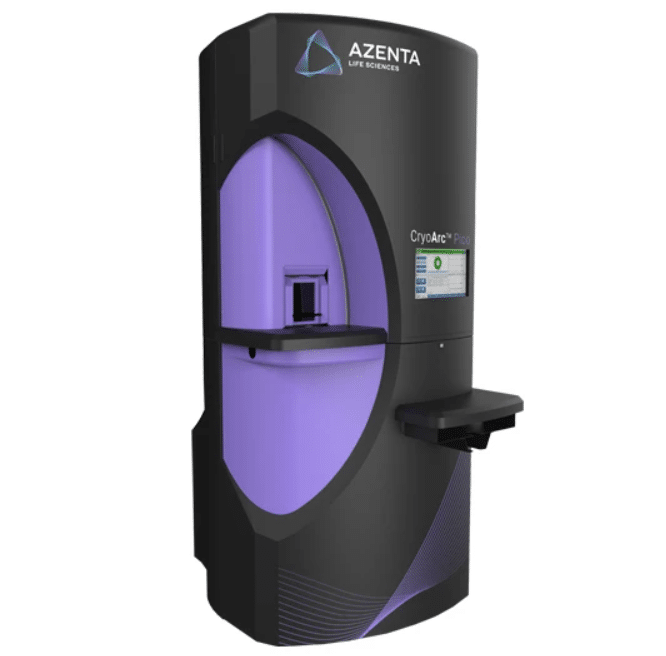
CryoArc™ Pico
Engineered for laboratory and decentralized point-of-use clinical research spaces. Fits easily under standard 8-foot ceilings and stores up to 8,800 x 2.0 mL vials or 400 x 25 mL cassettes.
- Capacity (2.0 mL vials) 8,800
- Static hold time 10 days
- Vapor phase temp. -190°C
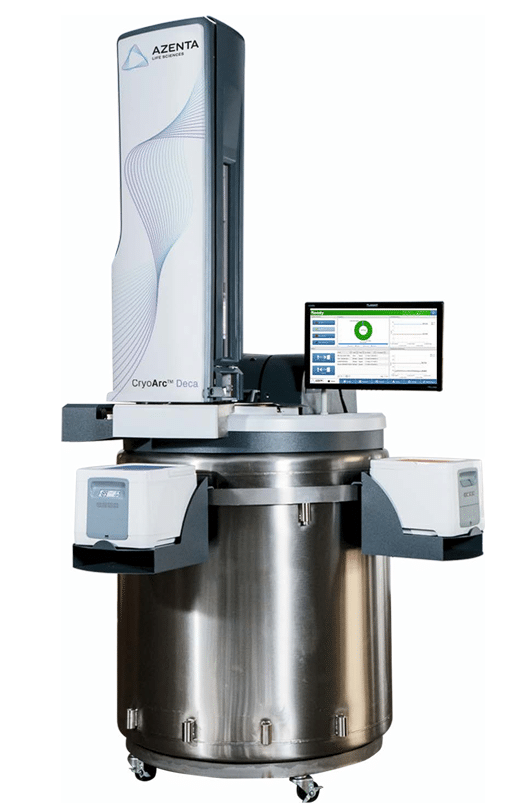
CryoArc™ Deca
Designed for high-density institutional repositories. Accommodates up to 26,600 x 2.0 mL vials, multi-type SBS racks, or cassettes up to 50 mL.
- Capacity (2.0 mL vials) 26,600
- Static hold time 15 days
- Vapor phase temp. -190°C
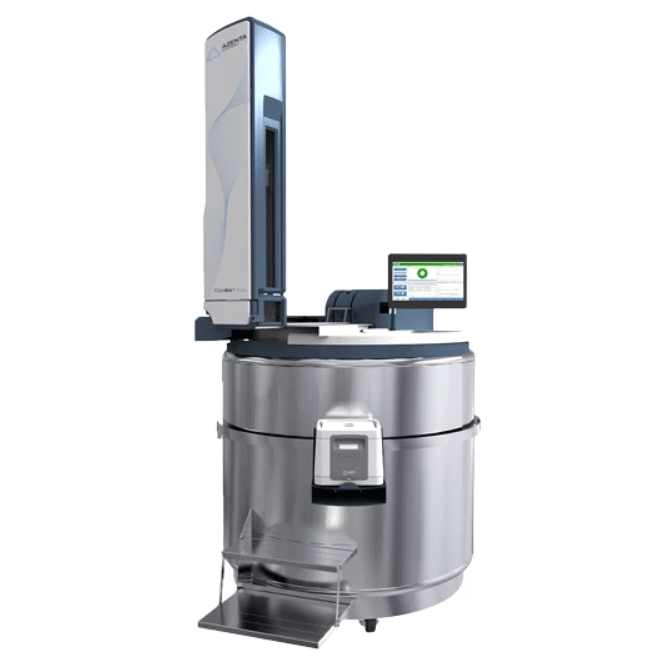
CryoArc™ Tera
Built for high-throughput enterprise biobanking and cell and gene therapy (CGT) cleanroom lines. Tera for Cassettes processes exactly one container element at a time to isolate patient lots.
- Box capacity 630 boxes
- Cassette capacity 990 (250 mL)
- Hold time (std / cassette) 21 / 23 days
- Vapor phase temp. -190°C
Technical Support and Infrastructure Lifecycle Management
Deploying an automated cryogenic preservation platform involves detailed engineering planning that extends well beyond purchasing standard laboratory hardware. Managing facility floor load capacities, configuring automated liquid nitrogen supply lines, designing vacuum-insulated piping (VIP), ensuring enterprise data synchronization, and satisfying regulatory compliance audits require professional oversight to guarantee seamless execution and minimize operational downtime.
Comprehensive site planning, preventative maintenance, technical support, and hands-on application training form the foundation of a secure transition to automated cold chain governance. From the initial layout optimization and workflow audits to formal system validation, calibration, and ongoing team onboarding, dedicated technical execution ensures that high-value biological assets remain secure, audited, and compliant with international biobanking best practices.
For expert technical guidance, custom layout modeling, or to design an automated storage solution tailored to your facility’s operational demands, contact the Rhenium Bio banking specialist team.
