

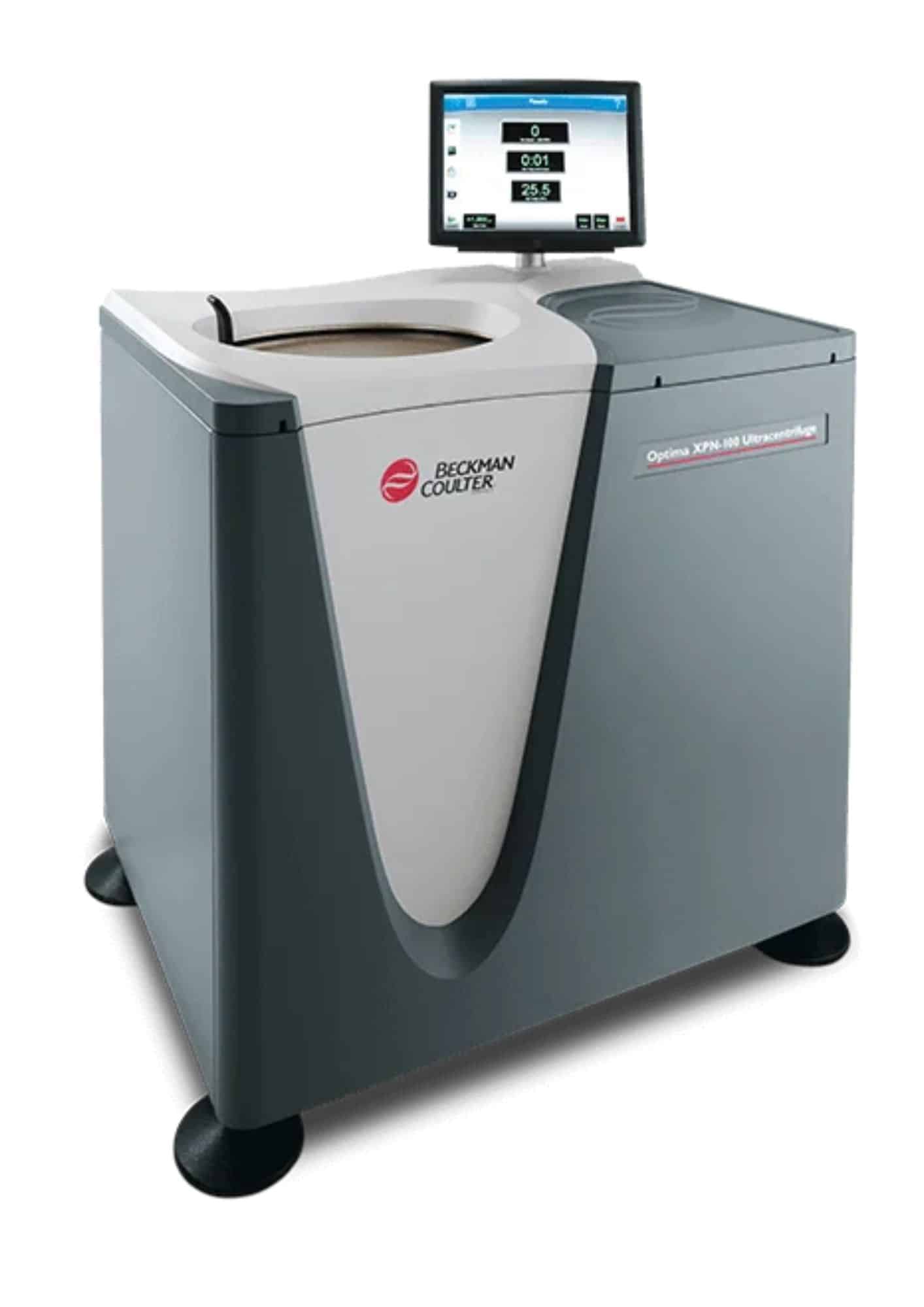

Optima XPN Preparative Ultracentrifuge
The Optima XPN is a high-performance floor-model preparative ultracentrifuge engineered for the isolation, fractionation, and purification of macromolecules, cellular organelles, and viral particles. Operating across three configurations—100,000 RPM, 90,000 RPM, and 80,000 RPM—the platform generates maximum centrifugal forces of up to 802,000 x g. This system is heavily utilized across academic core facilities, biopharmaceutical process development (R&D), industrial quality control (QC) laboratories, and clinical virology centers for high-resolution macromolecular separations. Designed for precision preparative workflows, the system utilizes a highly efficient thermoelectric refrigeration system (free of CFCs and ozone-depleting chemicals) that maintains strict temperature control within +/- 0.5 degrees C of the set temperature. Speed control is regulated within +/- 2 RPM of the set speed at velocities above 1,000 RPM. The drive system features quiet-drive technology, maintaining operational sound levels below 51 dBA to ensure a quiet laboratory environment.
Core Technologies & Operational Features
-
Advanced Software & Simulation: Equipped with proprietary Optima eXpert software, providing on-board calculations, simulations, and reference tools. This allows operators to mathematically model sedimentation profiles and optimize protocols prior to initiating physical runs.
-
Rotor Versatility & Tracking: Compatible with existing Beckman Coulter preparative rotors, including Fixed-Angle, Swinging-Bucket, Vertical-Tube, and Near-Vertical configurations. The system logs and tracks detailed rotor usage history and life cycles by individual serial numbers to ensure instrument safety.
-
Specialized Operational Modes: Features step-by-step dedicated screens for Zonal and Continuous Flow (CF) operations, standardizing the scale-up and processing of large-volume separations.
-
Data Integrity & Traceability: Supports multi-user environments with 50 unique user profiles and passwords under three distinct user access levels. The software generates exportable run logs and supports electronic signatures to maintain a strict chain of custody and GxP compliance.
-
Power & Run Stability: Engineered with enhanced power tolerance, automatically adjusting transformer taps to handle voltage fluctuations between 180 VAC and 264 VAC. In the event of a power interruption, the system tracks and records parameter data to verify if the run remained within acceptable boundaries.
-
Energy Management: Utilizes a regenerative braking system that reclaims deceleration energy and returns it to the local electrical circuit. During idle states, power consumption is minimized to the equivalent of a 60-watt light bulb.
Primary Preparative Applications
-
Preparative Density Gradient Separations: Execution of Rate-Zonal (separation by size/shape) and Isopycnic (separation by buoyant density) centrifugation using gradient media such as Cesium Chloride (CsCl), Sucrose, or Iodixanol.
-
Viral Vector Purification: Concentration, isolation, and downstream cleaning of Adeno-Associated Virus (AAV), Lentivirus, Adenovirus, and enveloped viral particles for gene therapy and vaccine development.
-
Extracellular Vesicle & Exosome Fractionation: Differential pelleting and subsequent gradient purification of exosome subpopulations from cell culture supernatants or physiological fluids.
-
Subcellular Component Isolation: Separation and isolation of intact organelles (mitochondria, nuclei, microsomes, lysosomes) and plasma membrane fractions.
-
Macromolecular & Nucleic Acid Fractionation: Isolation of ribosomal subunits, multi-protein complexes, plasmid DNA, and chromosomal DNA fractions.
Looking for the complete solution? Discover how OptiMATE, Optima XPN, and OptiXTRACT integrate seamlessly into an end-to-end separation workflow. Visit our Knowledge Center Hub.
| Manufacturer |
|---|


